Good Friday Gift

Each year, Savior takes up a special offering on Good Friday to support our neighbors in need. This year, our Good Friday gift will help provide stable housing for recent refugees and immigrants, through World Relief Chicagoland. Newcomers need help with security deposits of first and last months’ rent; and the need for housing is great, as asylum seekers are bussed here. Learn more from the flyer at the Info Table in the lobby at PHCC. You can give any time during Lent: write “Good Friday” in the memo line of your check or select “Good Friday Gift” as the fund on Savior’s online giving page.

Connect with the stories below of those World Relief helps:


Farzana is an Afghan Paralympian who was forced to flee Kabul in August of 2021. As a leader and advocate for women in her country, she was no longer safe. She found herself living in temporary quarters at Fort McCoy in Wisconsin. After several months, she was sent to Chicagoland for a better living situation. Because of partners like you, World Relief was able to find a place for her to live that accommodates her mobility devices.


Yomardy left her home in Venezuela to come to the United States on a Fulbright scholarship. Fully intending to return to Venezuela and use her status as National Teacher of the Year, she soon discovered that she was declared an enemy of the state in Venezuela. Her honesty about the conditions in her country meant that she could no longer return to her home. Thanks to partners like you, Yomardy was able to find support and a place to call home here in Chicagoland. Her new dream is to buy a house to be able to welcome others like
her who need a place to call home.


Jerome lived in a refugee camp for 19 years. Can you imagine that? During his time in the camp, Jerome was already working to make a difference and that made him a target. Thankfully, he was selected to be resettled and came to the United States. When he arrived at his first apartment, he was finally able to live in a secure and safe place. He was able to find peace again thanks to people of peace who supported the finding and filling of his new apartment.

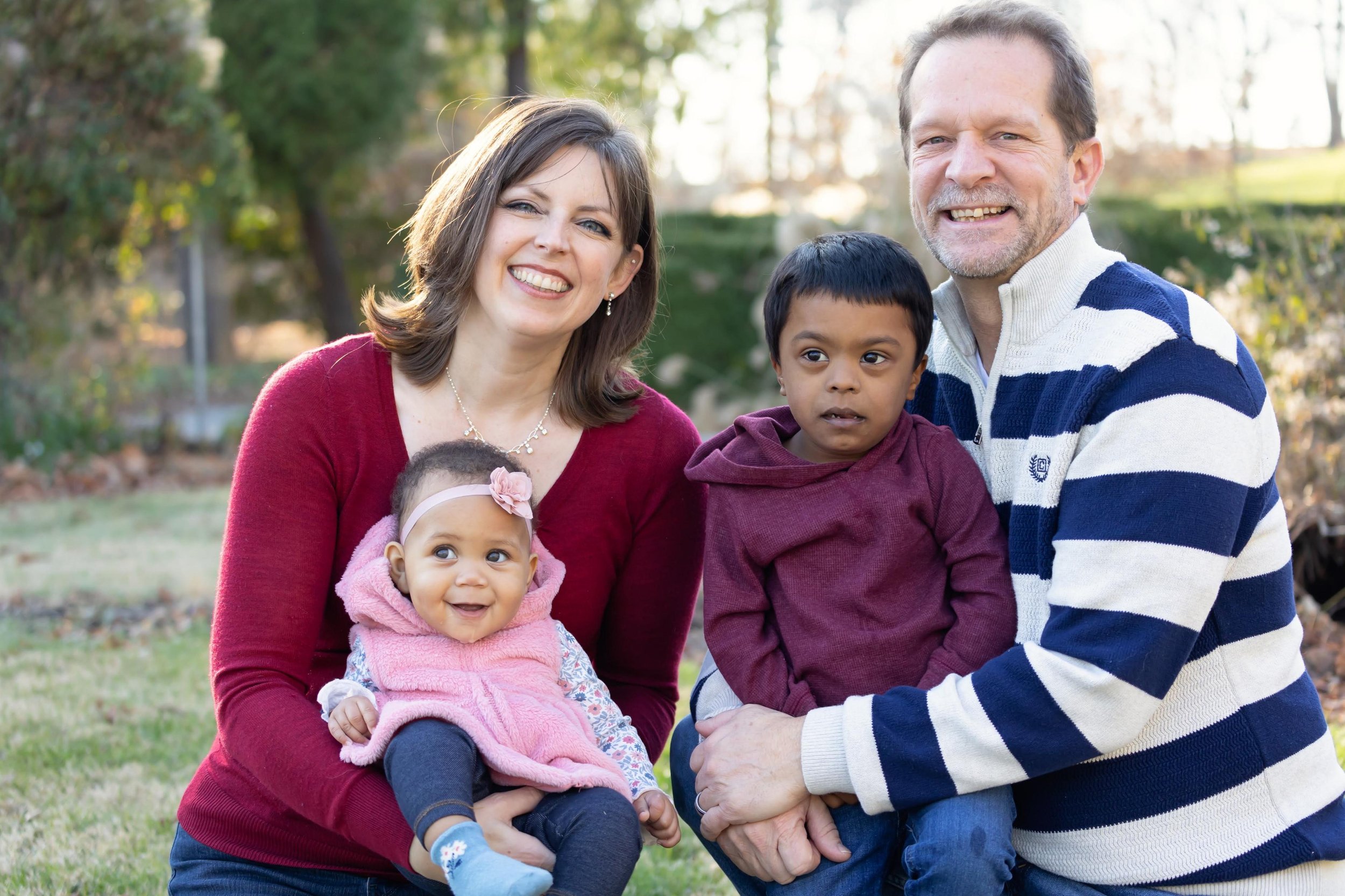
A Conversation with Rochelle & Barrett Scheuermann

Photo Credit: Kristin Page

How did you two meet?

We met much later in life than most. We were paired on eHarmony, and after the obligatory question phase, we quickly moved to emailing. There were no pulled punches. Rochelle’s first email to Barrett said, “So today I preached at my church… what are your thoughts on women in ministry?” Barrett’s answer was supportive, and the way was opened for meeting in person.

It was in December when we had our first date, and Rochelle decided to bring a plate of ginger molasses cookies with her. Her thinking was simple: “If the date goes well, Barrett gets the cookies. If the date goes poorly, Rochelle will eat the cookies on her way home.” We got kicked out of the restaurant at closing time, and Barrett was presented the cookies. We were married 8 months later.

You’ve had the recent adventure of adopting 2 children. What has that been like?

We always wanted to have a family and thought two children would be a good number. But at our ages, that proved more challenging than we had anticipated. We struggled with fertility and embraced that adoption was God’s way of adding kids to our lives. Never did we imagine how great or crazy this would be! There were times in this process where it was really challenging. Dealing with the disappointments of miscarriage and the unrealized hopes of adoption as we waited meant there were tears, questions, and many prayers.

When we first heard about Isaac, he was 2 weeks old. Without sharing the sacred details of his birth, we were presented with the profile of a baby boy with Down syndrome and other medical concerns and were cautioned to seek medical advice before allowing the match consideration to go forward. We had 18 hours to say yes or no to moving forward. It would have been hard to turn Isaac down because his profile came with pictures (and as many of you know, he’s adorable!), but we talked with a doctor friend to hear projections about the future. Her biggest suggestion was that if we proceeded, we would need to consider moving to a bigger town to allow for greater access to the care he would need. We talked with our parents and prayed and decided that we did want to proceed with the match and see where God took it. We didn’t know that in saying yes, we were the only family out of over a hundred who did. In a miraculous move that can only be ascribed to God, two days later Rochelle was unexpectedly contacted by Wheaton College about a job possibility. With our heads spinning, we realized God was up to something. Exactly two weeks after being presented with Isaac’s profile, we were walking home with him, and two months later Rochelle was hired at Wheaton. While the journey has included a ton of doctor’s visits (one year alone included 3 surgeries and over 50 medical and therapy visits!) we are exceedingly grateful for the bundle of energy (!) and joy that Isaac brings to the world.

How did you happen to adopt again?

We had always been told that 2 weeks (from initial contact to holding the baby) was a fast adoption. Isaac’s adoption finalization, however, was slow. It took us a couple years, and so we were delayed in seeking a second adoption. When we did, we were a little unsure. We wanted a second child and thought Isaac would be a great big brother, but our ages made us doubt. Friends we grew up with were becoming empty nesters and grandparents. Were we really wanting to take on another infant? We prayed and felt led to at least keep our home study active. Our adoption agency was tiny and encouraged us to connect with other agencies in order to broaden our reach, but our fleece before the Lord was that we wouldn’t do more than keeping our home study active with our present agency. If God wanted to add a second child, he would. If our home study expired first, we would take that as God’s direction that we were to be a family of three.

As our home study neared expiration, we both had mentally started to move on. But unexpectedly we got a call. On a Tuesday night in March, our agency called to say we were being considered with several other profiles for an adoption. While this excited and terrified us, we anticipated a usual timeline, giving us time to prepare. How wrong we were! With the birth mom in active labor, we were informed that we were the top pick. We had until the morning to give a yes or no (less than 12 hours). We were literally left speechless. It took us several minutes to even find words. It was clear very quickly that God had a new kiddo to add to our family and that he had an incredible sense of humor. Less than 22 hours after we were first contacted by our adoption agency, we were holding our baby girl. We had no clothes, no formula, no crib. We had to borrow our social worker’s car seat to get Annelise home! It took us a good 6 weeks to really get our heads around what just happened, but we have never once regretted the speed. Adding Annelise to our lives has been a joy beyond anything we could have anticipated, and we are so grateful for her calm and joyful spirit. (Nursery workers, she really doesn’t cry all the time!).

Where do you see God at work as you raise these children?

Even though we get called Isaac and Annelise’s grandma and grandpa from time to time, we don’t regret adoption in our “older” age. God knew this was our time. and he is sufficient for this unusual journey we have all undertaken.

Perhaps the thing that amazes us most is how we see God already using our children. Isaac endears himself wherever he goes, and we find that the joy and togetherness he brings with his presence is truly sacred. Isaac loves to sing and lights up with the liturgy at church (as many of you know). He once mentioned Father Kevin at home and immediately put his hands out announcing, “For the people for God.” His love of God--and the ways he shines this--pulls others around him into joy and worship. Annelise is a bright, smiley girl who brings calm and joy to others.

Raising a special needs kiddo has challenges, and there are areas where we are exhausted and times when we feel utterly defeated. It takes us longer to get to certain stages and even longer to get through them. And at our ages, when most of our peers are moving to the empty nest stage of life, we sometimes feel a little on the edges because we’re just starting out. But then we realize that God knew this all along and we not only feel blessed with how God has equipped us to parent now, but we also look at the amazing community God has gifted us: our family, Church of the Savior, Early Childhood, and a great team of medical professionals. We know that we are not alone in the burdens we carry, and we get the great privilege of sharing the overwhelming joys that we experience, too. So don’t mind the extra gray hairs that you see us sporting these days. We are exceedingly blessed to have walked an unusual path. Some may say we’re late bloomers, but in God’s plan, we’re just on time.

A Conversation with Connie Blair


You spent the entire summer in the hospital. What was happening?

For most of my adult life, I have suffered from several autoimmune diseases (an increasingly common class of disease in which the immune system harms the patient’s own tissues andorgans). These chronic illnesses have caused me a variety of problems over the last 18 years, notably including a minor stroke at the age of 39.

A few years ago, we discovered that my illness had caused extensive damage to my liver. This was managed, with variable success, with medication until January 2022, when my symptoms worsened and stopped responding to treatment. At that point, my doctors and I decided it was time to start preparing for an eventual liver transplant.

In May, I underwent a procedure meant to mitigate some of my symptoms as I awaited transplant. The procedure improved some of my issues, but I also experienced many complications and side effects, some of which landed me in the hospital (Northwestern Memorial) in early June.

In the hospital, my condition continued to decline, and my medical team struggled to keep me healthy enough to remain eligible for transplant surgery. Meanwhile, my liver failure was accelerating, meaning I would likely need that surgery far sooner than previously expected. After days of hard work and discussion, my doctors decided that I was strong enough for transplant. Early the next morning, July 12, a doctor informed me that they had identified a liver match for me from a deceased donor in Michigan, and I was quickly prepared for the operation. After 9 hours of surgery, I had a new, working liver and an incision that would become a 16-inch scar.

My recovery from the transplant was as rocky as my path to it, in part because I had been so unwell going into it and deconditioned from my long hospital stay. So I spent another two months after the surgery in a combination of ICU, general hospital wards, and physical rehab facilities. I was hospitalized for a total of 12 weeks.

That sounds overwhelming. What was hardest about your hospitalization and time in rehab?

Probably the fact that, over the course of the summer, I had so many different problems that arose in such quick succession. We would barely begin to address one symptom when several more would emerge. The human liver has more than 300 distinct biological functions, so liver failure can cause seemingly innumerable issues. And, of course, a long hospital stay can cause its own problems.

I entered the hospital with severe edema in my legs and feet, and almost immediately developed severe pain and muscle spasms in my left leg and foot that quickly left me unable to walk or even move around much in my bed. I had episodes of irregular blood pressure, heart rate, and blood oxygen. Fluid accumulated around my lungs and heart. I had serious problems with digestion, swallowing, breathing, and sleeping. I was covered in bruises--some from my many injections, IVs, and blood draws, but others with no clear cause. In the few hours of sleep I could get, I had vivid, distressing dreams.

My many medications produced side effects like tremors so severe I couldn’t feed myself and mineral deficiencies that had to be treated with painful, hours-long infusions. My rapidly fluctuating body chemistry, the result of frequent medicine changes and my liver’s declining filtration capacity, gave me bouts of intense anxiety and paranoia. I had many episodes of altered mental state--times when I couldn’t think or speak fluently, or periods of delirium and stupor. There are several periods, lasting hours or days, that I can’t remember at all.

​Did God meet you in this time—and if so, how?

Throughout my years of illness, including this hospitalization, God has consistently met me through my friends and community. I always knew I had a large group of people keeping up with my situation and supporting me with their calls, visits, and prayers. One friend was inspired to construct a prayer network of friends and family around the world to intercede for my healing. Another was always available for a phone call when I would wake up gripped by panic in the middle of the night. One friend flew from her home in Massachusetts to stay with me in the hospital for a week when none of my family could be here.

More than anyone else, my mother was God’s hands and feet and voice to me throughout this ordeal. She and my dad had been visiting me in the spring when my health really started to take a downward turn. Dad had to go home to go back to work (he’s a pastor in New York state), but Mom stayed with me as things got worse, and was with me nearly all day, every day of my hospital stay, clocking literally hundreds of hours on I-290 getting between my home in Glen Ellyn and the hospital. I couldn’t have gotten through this without her, as I often was not in good enough condition to manage my own care, and I needed more attention than my nursing staff had time to provide. She kept my friends up to date on my roller-coaster condition with regular emails. She also stayed with me for several weeks after my discharge, while I still needed lots of help. I don’t have words to describe the blessing I received from her this year.

You were able to return to worship recently. What was that like for you?

Prior to my hospitalization, I hadn’t regularly attended in-person worship in some time, since my medical issues put me at high risk from the pandemic and my declining health left me with very little energy. I started attending Savior remotely during the pandemic, so when I went into the hospital, I don’t think anyone in the church but Fr. Kevin and Mtr. Karen knew I was attending! And yet, even though almost no one in the congregation knew who I was, you prayed for me. You prayed together weekly, in the Prayers of the People, and intercessors were called upon at many points of crisis. Returning to worship with this community that had held me up to the Father with such faith and care felt like an outpouring of God’s love. I feel acutely aware of the great answer to prayer I’ve received in my recovery.
Beauty for Ashes: My Testimony 

Longtime Savior member Barbara Walker passed away on August 25, 2022. Despite difficult life circumstances she discovered God’s faithfulness and his restoration of her life. Below is an excerpt from her book, God Has Been Faithful, reprinted by permission.  

Beauty for Ashes: My Testimony 

2009 

I was the firstborn of two and grew up in Oak Park, Illinois. I attended the Methodist Church every Sunday with my mother but had a father with a traveling job who wanted to relax on Sunday and attended with us only on Easter and Christmas. His “church” was training for seven years to become a worshipful master of his Blue Lodge in Freemasonry.  

After confirmation I asked Mom for permission to attend where my friends were, so for high school and college I was a Presbyterian. Then I married a Lutheran. We had three children and ten happy years. He also was a traveling man and died on the road at age thirty-five. I was thirty-three and devastated.  

I went back to teaching elementary school, working on graduate hours and raising the children. Five years later I married again and moved with my ten-, twelve-, and fourteen-year-olds to Minnesota. I learned within six months that the marriage was abusive physically and mentally and that he was not interested in my children. I wanted a father for them.  

Within two years I lost my best friend--my mom– to cancer, twenty days after my firstborn son died in a suicide at age sixteen. At this double loss I was totally broken and turned to Jesus for salvation at age forty. I was the first Christian in my family. I was saved by the side of my bed on October 26, 1972, and received the Shekinah light for one and a half days and knew I had been in his presence. I received the baptism of the Holy Spirit a year later on my knees in my kitchen after hearing Father Dennis Bennett speak in the Episcopal church.  

I was saved two years into the misogynistic marriage and remained for fourteen more. After discovering his pornography, infidelities, and sexual addiction in 1984, there were three interventions over the following two years. John admitted his need and agreed to get help but would not, and the separation began. Five years later there was a divorce. My daughter led him in the sinner’s prayer before he died a few months later.  

I worked for the Lord for seven years, aglow with the awe of salvation. But in 1979 came my Tarsus or wilderness journey for ten to thirteen years. My life was falling apart. I was being stripped to my foundation. I discovered in me a dysfunctional codependent, a bent creature, in whom lies no good thing. I didn’t know who I was. I found a compliance that had to be transformed into courage and boldness–and fear of authority and intimidation that melted as I discovered who I was in Christ and Whose I was. I had to learn to be assertive and to walk in the authority and wield that power of the Lord Jesus Christ where He has given us dominion.  

I also had to get into my heart the scriptures we as biblical counselors are so often called upon to use with people in difficult circumstances or without hope. Practically, I am walking this out with small group work: Bible studies here at Windsor Park; with people from my church in our home; prayer groups; government prayer at Windsor Park; discipling of individuals; and lastly, but part of my call, walking alongside Jewish people.  

I believe I am called to edify, to encourage, and to exhort with His truth, to speak a healing word, a discerning work. I believe in passing on to others the exciting adventure of journeying to wholeness in Christ Jesus and demonstrating his life to others by the power of the Holy Spirit.  

God has been faithful! 

St. Cyprian of Carthage

St. Cyprian of Carthage

Another pastor steps down amidst scandal. Another victim steps forward to name her abuse. Another angry Christian goes on a social media tirade. Another fracture. Another revelation. Another schism. Another person leaves the Church disillusioned.

I don’t know about you, but I feel exhausted and discouraged as I look at the state of the Church today. Why are there such deep divisions? How many more revelations of abuse can emerge? How much more can we handle? It can certainly be overwhelming, and it’s hard to know exactly how to move forward faithfully. All I can pray many days is: Lord, have mercy on us. 

At first glance, the early church may seem like the strangest place to look for wisdom navigating our contemporary context. The ancient world just feels so distant, so other. Yet, in reality, aspects of life in the early church mirror our own tensions: a pluralistic religious and philosophical context, warring political factions constantly vying for power, Church leaders who sought to faithfully follow Christ but often failed, a culture opposed to Christian teaching in fundamental respects. The similarities are stunning when you begin to read the narratives that pagans leveled against the early church. 

St. Cyprian of Carthage was a North African leader in the early church. A Black man of Berber descent, St. Cyprian was born and worked in the major urban center of Carthage, one of the largest cities of the Roman Empire at the time. Cyprian had been well educated in pagan philosophy and worked in the prestigious role of public orator and teacher of rhetoric until he was converted to Christ in mid-life. It was the humble witness of an elderly priest named Caecilianus through which Cyprian came to know and love Christ. Cyprian later recounts how everything changed after his conversion to Jesus Christ as Lord. In a world that confessed “Caesar is Lord,” St. Cyprian proclaimed that “Christ is Lord.”

St. Cyprian was ordained shortly after his conversion and quickly rose to prominent leadership. He was catapulted into public controversies early on. One of these debates, the “Novatian controversy,” centered on the question of how the Church should respond to lapsed Christians who had faced persecution and recanted their confession of Christ. If these lapsed Christians returned to the Church with contrition, should the Church permit them back into Communion or withhold Communion? A teacher named Novatian argued that they should be denied Communion. But Cyprian advocated that through penance and a time of testing, they should be readmitted to full participation and Communion. Though the path toward forgiveness and reconciliation required true sacrifice, St. Cyprian believed that God always offers a path of mercy through judgment. 

Later in life, Cyprian wrote a treatise titled “On the Unity of the Church,” in which he articulates a theology of the Church while reckoning with the harsh on-the-ground experience of ecclesial life. He famously wrote that “you cannot have God as Father without the Church as Mother.” Though the Church often fails in horrific ways, Christ has bound Himself together with this Bride. So you cannot have Christ fully without life in the Church to which He is joined. 

Saint Cyprian was so convinced of the goodness of Jesus Christ in and through the Church that, when persecution returned to Carthage, he endured unjust imprisonment and was beheaded in 258 for refusing to renounce the Name of Christ.

As I ponder the witness of St. Cyprian and how it illuminates our contemporary context, I can’t help but notice the parallels. The Church certainly is a mess today. We ought to be shocked and grieved at many instances of abuse emerging today. Jesus of Nazareth certainly grieved the failures of religious leadership that he encountered in the flesh. Deep moral failings require a strong emphasis on justice for the oppressed and judgment on perpetrators. And yet, God’s mercy remains for all people: for the victim of various forms of harm and for the lapsed leader as well. The Great Physician knows what remedy each person needs for healing our sin-sick world. 

Of course, no simplistic answer can reconcile all of the tensions and griefs we bear today. Only Christ knows the full weight of horror and what healing looks like for each of us. How are you seeking to make sense of our current divisions? How is Christ in the midst of it all?